Welcome

Dennis Jones is a Jamaican-born international economist, who has lived most of the time in the UK and USA, and latterly in Guinea, west Africa. He moved back to the Caribbean in 2007. This blog contains his observations on life on this small eastern Caribbean island, as well as views on life and issues on a broader landscape, especially the Caribbean and Africa.

*NEW!!! LISTEN TO BLOG POSTS FEATURE ADDED!!!*

*PLEASE READ COMMENTS POLICY--NO ANONYMOUS COMMENTS, PLEASE*

*REFERENCES TO NEWSPAPER OR MEDIA REPORTS ARE USUALLY FOLLOWED BY LINKS TO ACTUAL REPORTS*

*IMAGES MAY BE ENLARGED BY CLICKING ON THEM*

*SUBSCRIBE TO THIS BLOG BY E-MAIL (SEE BOX IN SIDE BAR)*


______________________________________

**You may contact me by e-mail at livinginbarbados[at]gmail[dot]com**
Showing posts with label Barbabos. Show all posts

Thursday, February 18, 2010

Barbados' Fiscal Deficit; Causes and Possible Solutions: Lunch Time Lecture, February 19

The next session in the Unity Bar lunch time lecture series will be on Friday 19, 2010. It will be devoted to a panel discussion in the Auditorium, George Street, Belleville, St. Michael. The topic will be "Barbados' Fiscal Deficit; Causes and Possible Solutions", and the panel will comprise:
Dr. the Hon. David Estwick, Minister of Economic Affairs & Empowerment, Innovation, Trade, Industry and Commerce,
Dr. Justin Robinson, Head of Management Studies Programme, Faculty Of Social Science, and
Mr. Wilberne Persaud, Coordinator, Banking and Finance Programme, Department of Economics, Faculty of Social Sciences, UWI, Cave Hill.

As usual lunch will be served from 12.30 pm and the lecture will start at 1.00 pm.

It promises to be a spirited discussion.

Saturday, February 13, 2010

Hold strain? Come again...

I read in today's Nation (page 6) that the Governor General is to get a new car, costing B$190,000, a spanking new Audi A4 sedan, reported to be the first of its kind on the island. I wont hide the fact that I find that report distressing as an indication of the wrong message to send to a nation at this time. As an indication of essential spending in a recession this passes no test that I could devise. If someone wants to tell me about prestige and image, I would say that when you are supposedly down to your shoes bottom those things should not be your concern.

I read in the same paper (page 3) that the Barbados Tourism Authority has had to pull out of promoting Crop Over during Trinidad's Carnival 'because of financial cuts': last year, they and the National Cultural Foundation spent B$80,000 on the same promotion, which was instrumental in bringing about 5,000 people from Trinidad for Crop Over.

Just three nights ago, the PM was discussing economic issues and talking about 'moratorium' as his angle, not wage freeze (see Nation report). I'm not going to get into semantics and what will make a moratorium (a delay or suspension) different from a freeze. All will be made clear soon when the PM meets the social partners. During the press conference, the PM is reported to have 'again pleaded with Barbadians to hold strain as Government attempted to battle the current worldwide recession by finding a mid-term solution'. He defended free bus fares for schoolchildren, and will continue the roll-out of the "controversial" Constituency Councils. He said that Barbados’ main challenge now was to repair the fiscal deficit, not deplete foreign reserves. The Prime Minister also took the opportunity to thank the private sector for holding back from lay-offs across the board, saying it had “pulled its weight.”

Today I also see a report citing the PM saying that 'Government will seek to protect taxpayers’ interests at all costs' (see Advocate report). The report stated 'Thompson stressed the need for such action, noting that it was the Government’s responsibility to maximise taxpayers’ returns, while also ensuring that their money was also well spent.'

I read about the plight of the QEH and junior doctors' complaints about the poor conditions and lack of facilities for them.

I recall just a week ago how the country did not have the resources to offer even one bed space to Haitians affected by the earthquake.

I am wondering how all of that sits together. If someone were asked to describe the government's attitude to holding strain in its affairs what conclusions would they draw? If asked what were the nation's priorities, what would they say? If asked if government were truly standing shoulder to shoulder with the private sector in carrying the burden of the recession would they agree?

Tuesday, September 22, 2009

Why Has Barbados Left The World Behind? A Look At Doing Business 2010

As I comb through the reading material that the world's learned journals produce, I came across the latest World Bank report on Doing Business 2010 (see www.doingbusiness.org). I was not surprised to find Singapore in first place or that the Central African Republic was last (#183).

I eagerly thumbed through the document online searching for Caribbean countries, but first I wanted to see how high Barbados was relative to the others. Hello? Is anyone there? Barbados? Where are you? I could not find Barbados anywhere.

I found Barbuda (ranked #51, as always with Antigua). I found The Bahamas (#68). I found Jamaica (#75) and Trinidad (#81). Is the money being spent tempting people to come to invest in Barbados being done on a wing and a prayer? How is the world investing community supposed to know how Barbados stacks up against the rest of the world, or the Caribbean alone? I get it. They just come on a plane and soak up the business making environment. Why waste time on a survey. I hope someone at the World Bank or in one of the government's economic ministries has a good answer--a very good answer. I think back to the past week of PM Thompson glad handing in Florida and I wonder if the "Bajan" way is just more smoke and mirrors.

Puetro Rico (#35) and St. Lucia (#36) do best in the region. But nowhere could I locate God's isle. If you do not believe me, then look at the regional table for Latin America and the Caribbean (see table), which I also reproduce below.

*********************
Latin America & Caribbean

[Clicking the headers below will sort data by column (try it and see).]

EconomyEase of Doing Business RankStarting a BusinessDealing with Construction PermitsEmploying WorkersRegistering PropertyGetting CreditProtecting InvestorsPaying TaxesTrading Across BordersEnforcing ContractsClosing a Business
Puerto Rico1130321321522124
St. Lucia244210185220278
Colombia3128126912016256
Chile41112153131148418
Antigua and Barbuda5861015275216510
Mexico61492514911161182
Peru719242322312151816
Bahamas, the8920727132033215
St. Vincent and the Grenadines9611125185751528
Jamaica1021162018153021221
St. Kitts and Nevis111331281851461828
Panama123132973202912012
Belize132724221823625293
Trinidad and Tobago14101583233543028
Dominica155716171358142828
El Salvador1620262147232210213
Dominican Republic1718171916131392924
Grenada187592918511132628
Guyana19161018931151912721
Guatemala20283124112517261615
Uruguay21232913307182729117
Nicaragua221528172618182817311
Argentina23243220189202323114
Costa Rica2422272259282692317
Paraguay2517223011131318311720
Brazil2621232619181525181322
Ecuador272916278182510281423
Honduras282614281232824243119
Haiti293225523292813301027
Suriname303119143129321193225
Bolivia313021322427253127249
Venezuela, R.B.322518311332313232626
*********************

How utterly strange, I thought. With all of the IMF's recent commentary and concerns about the need to keep investor confidence high the last thing I expected was to find that Bim had gone AWOL in the eyes of potential business people. Is the country serious about moving ahead, not just out of the current recession?

The Economist does its usual nice job on summarising the latest report (see Reforming through the tough times). It shows that a lot of reforms have occurred since the last report. It's interesting that countries tend to emulate the 'leaders' in the region--more reason to see Barbados, showing what it means to be out in front.
  • Encouragingly, reform seems to be contagious. Countries try to emulate leaders in their regions. Many African governments, for example, have taken note of the success of Mauritius’s deregulated economy (#17).
The Economist reports that reforms matter a lot:
  • Lower barriers to entry are associated with a smaller informal sector. Informal businesses have lower wages, lower growth rates, poorer safety records, tend not to pay taxes and are prey to corruption. Reducing the cost of doing business leads to higher rates of growth and entrepreneurship.
  • One study shows that, in poor countries, a ten-day reduction in the time it takes to start a business can lead to an increase of 0.4 percentage points in GDP growth. Another shows that people who have a formal title to their property invest as much as 47% more in their businesses.
  • The best reformers have several things in common. Their reforms are part of a broad agenda of boosting competitiveness.
So, with all of these good things to come from reforming the business environment, why is Barbados apparently not in the race? I promise not to mention again my view about the perceived myth of Barbados' economic success, really I do.

A query to the World Bank in Washington DC, got the following explanation:

'The Doing Business report includes 183 economies. Since the launch of the first report in 2004, economies are added to the report based on their request. The Doing Business team has recently received a request from Barbados to be included in the report, and we expect that Barbados will be part of next year's report.'


Tuesday, September 15, 2009

Hot Air And Trial Balloons-REDUX: Now We Have A Green Paper On Immigration Policy

A few days ago, I speculated about the way the government was dealing with immigration policy (see 'Hot Air And Trial Balloons'). I see in the Nation, September 11, that all is now clearer. The government has prepared a 'green paper' (a document for public discussion and comment). The newspaper report indicates that the paper has also been sent to CARICOM leaders for their feedback.

This was made clear while the PM was in Florida last week--not sure which parish that is and who is the MP. Maybe a similar announcement has been made on these shores, but I have not seen it.

One highlighted aspect of the paper will be to deal with a law that gives illegal aliens automatic citizenship of Barbados if they are resident for 10 years continuously.

The article indicates that the government is 'vowing to implement its immigration plan by next January'.

What I wrote on September 7 was:

What does make sense is that the government wants to have a good sense that it can be tough on immigration, but the question is how tough, given the obvious sensibilities in the region. These are naturally based upon any sense that a particular nationality is being targeted; in that regard the noise has been loudest from Guyana, but also loud from St. Vincent. Sensibilities are also raw when it seems that moves toward regional integration are being sacrificed for narrow national interests.

So, where are we? The Barbadian public has sided with the PM. This has frozen the opposition because who wants to walk in front of that bus? But, still the real action is yet to be taken. It is a political game that is underway and as the year passes the likelihood that the policy will not see the light of day before the year's end and the end of the amnesty seems to grow.[My emphasis.]

If some aspects of how government is working are so clear to those who do not do much more than take a cursory interest, why not save the people's time and make things clear? Seat of the pants government is always fraught with unnecessary bruises and blisters.

****************************************************************************
I cannot find the article online but it's entitled "Alien Law Check" and appears on page 3.

Friday, August 28, 2009

Ants And Sugar

You should be familiar with the fact that ants like to find sugar. When they do, they take the little grains back to their nests to do ant-like stuff. This week, I fell onto the wrong side of two little children (a boy and a girl), aged around 8, whom I had only met the week before. But, let's call it a 'fatal attraction'. I really like the kids, both of whom are of Jamaican parentage: the girl lives there, the boy has lived in a variety of places including Barbados and the USA. Each is quite different, but similar, nevertheless. It started badly when I first met them and the boy asked me a set of "Why are you here?" questions. I explained, I thought politely and gently, that I was there to see his mother and that it really was not for him to ask me the question more than once. I got his girl cousin to explain to him, as my attitude is 'typically Jamaican'. She did and I thought all was cool. But, back he came again. I tried to give the message again. The two kids went away to the pool, but were hovering around me again in minutes. I can understand the curiosity that comes from a first meeting.

But, then, things took a bad turn. The boy's mother returned and he said in a flash "He's been mean to me." I took a breath and told him to hold on. I asked him to tell his mother what had happened and for his cousin to back up or correct his story. He told his side. I then told the mother my side, and said that I thought the boy should be very careful when making the kind of statement he had. All seemed cool, again. But I heard that the mother had to spend some 30 minutes calming her son who was now very upset. Fast forward.

I met the children again and we did a few fun things together. I went along to the house they were in to help lower stress with the arrival of a moving van and its contents. I was really doing that and trying to do my usual business, but in company rather than alone. After the first moving day, I passed by the next day, when the movers were due to assemble some large items and the mother needed to leave the house. When I met the children, they quickly reverted to "We're bored." I remembered that I had a wad of cash that needed counting and asked if they could do that for me. They agreed. I gave the girl a smaller wad and the boy more bills--it was just how the money had been, and I had no clear idea of how much was in each bundle. I just asked that they take care and not let the bills fly away. They sat nearby and started to count.

The girl 'finished' first--they say girls mature faster, so no surprise, I thought. She told me "57 dollars," and handed me the bills. I looked puzzled. I saw a 100 dollar bill in the pile. I asked, "Is 50 less than or more than 100?" She got it right in a flash. "How then can this be 57, when there is a 100 in the bundle? Have another go," I told her. In another flash, she said "166." I did not take the bundle. I asked if she was sure and she nodded. I then asked "What is the difference between 166 and 157?" She paused then gave the answer 10; then 12; then a series of other numbers. I then asked about the differences between 17, 27, 37, 47, 57, 67, etc. She got most of them wrong! We did a bit of elementary arithmetic and she seemed fixed. So, I asked her to tell me the difference between 167 and 157, and she was right with 10. I asked then for the difference between 167 and 166. Again, 10. Wrong! We did more maths and used more fingers and got to 1, eventually. I had by then had the housekeeper come to witness and she had tried to help by going over the fact that difference is subtraction. The child knew the process but just could not apply it.

Then, to the boy. He had been riveted by his cousin's task and had made no progress. So, I asked him to start and let me know his total. After a few minutes he got up and left and did not get back for about 10 minutes. I asked him if he had finished. He said he had not and started to count again. But then went off again, and he and his cousin came back with 'noodles' to play with in the pool. I looked at my money, lying on the chair, but said nothing. After some splashing, Noodle and Doodle came back. I went to the matter not-in-hand. My money had blown around and was lightly strewn. I picked it up and counted the bills. "1015 dollars, US" I said and wrote it down on a newspaper. "Let your mother know what happened when she comes back," I said. Then, I made a terrible error. I added "And please don't go crying to her about what happened." I realised that I needed to get off and try to write an article and that my mind was not going well with the elves.

The mother and I did not talk until way into the afternoon and she told me that she was very unhappy with how I had treated her son. I let her eat my head and apologized. My saying that there was no way that I would let her son fall into being a possible victim at school in a foreign country because he was known to run and tell and cry sounded good to me, but was not going to sway a mother. I would try my best to not let it happen again. She wanted me to show the boy that I had a good view of him too and I told her that I had done that, though not when she was nearby. I saw the boy again the next day and gave him nothing but lerv. He was pucker and chipper and full of fun with his cousin and another boy his age, all three curled on a sofa with some American cartoon playing. I think we are cool. But I have a task on my hands, of a sort.

When I retold the story to some people they said that I had intimidated the children and that they clearly could not function as a result. I begged to differ. They had said they could do the task--and I take children at their word. The first set of arithmetic mistakes made no real sense except that the child would not apply what she had learned. She even used her fingers yet found 10 fitted some many wrong situations. The boy was another story. He had been forgetful and that happens. But having forgotten he had done nothing else once reminded of what he had agreed to do. I do not see reminding him of that is intimidation. However, if one does then therein lies some interesting days ahead with children and people. There is history here, however.

The people who had seen my actions as intimidation were also the people who had not seen fit to correct a child's behaviour that they had found offensive, arguing that it was not their job to do that. I had extended that discussion to say that the uncorrected child would then find a very angry adult one day and get the chewing out that was avoidable. They also saw it as 'taking the law into your own hands' to do something to make another driver stop at a red light. I had told of how at a four-way traffic light, with all lights flashing red, I had arrived first, stopped, then moved my car into the junction and paused. My argument was that the oncoming bus, racing down the hill was obliged to stop first before it proceeded and I should not have been in danger. In fact, the real situation could have been that my car had stalled. Routinely, vehicles do not stop for flashing red lights in Barbados. People understand static red, but think that flashing red means roll on. I told of one instance where the bus had rolled on and a motorcycle cop on the other side had just roll in the opposite direction with nary a glance back. They had asked what if the bus had faulty brakes. I had replied that was no issue as the forensics would show the truth, and also ask any survivors from the bus if it had stopped anywhere along its route. It would be amazing if the bus had gone from depot to town with no stops. I had concluded by saying that the situation you live with is the situation you allow to exist.

I am not going to lambast any one in particular, but I will state my view. If you tolerate what you deem intolerable, please explain to me what you think you are doing.

Tuesday, August 25, 2009

Moving Moments.

This is a family story told by everyone affected. The events I witnessed, but I am only the writer now. The two children and a housekeeper will tell what they saw. The head of household will finish the tale. Moving countries can be traumatic, especially for children. They often slide along but that is not to be presumed. If things start well, they usually end well. Now, the story.

The men came to Sandy Lane and they started to unload a big truck with a lot of cargo.

When the men started to unload they brought in pictures, chairs, and a television.

These were elderly men ,who worked slowly and inefficiently. We asked them why no young men were in their crew/team. They said "They are sitting on the block." They also said that the boys had taken on 'our' culture: we are Jamaicans. The man meant that the boys were becoming Rastafarian. We got angry and told him that Rastas are not all of Jamaica and that he should not talk about another culture if he does not really understand what he is talking about.

The men also brought in kitchen items and bookshelves.

They brought in paddle boards. One is red and yellow, the other is green and blue. They are made from plastic, and have a warning sign that tells me that they are not life saving devices. Do not leave child unattended while in use.

The crew worked for seven hours, and took breaks for water and lunch (30 minutes). As the day wore on, the men seemed tired and looked haggard.

One of the children became restless and asked her 'uncle' (the author) if they could go for a drive. We went to a hotel to say a quick hello to some of 'uncle's' friends and we also went to a restaurant to have lunch. I ate chicken nuggets with fries and BROCCOLI and CAULIFLOWER and CARROTS. But I did not eat them. My 'uncle' tried to force me to eat the vegetables but it did not work. But he made me take them home for later. My face was not happy.

After lunch, the two children went into the pool for a swim. They did cannonballs. They did underwater handstands. When the boy came out of the pool, he cut his foot on a piece of metal. His foot bled and he trailed blood all over the patio. His 'uncle' cleaned up the wound.

As the team worked, we noticed one member who never went upstairs. He would unload from the truck and just climb two stairs with his box and wait for one of the others to take boxes from him.

It was now late afternoon and they continued to move things at their own pace. There was a new face: he started to help; he did not look as old as the others. With him, worked speeded up a little, and they finally finished the job after seven hours.

"You coming back tomorrow?" Asked the renter. "God willing," said one of the men. They are due to come to assemble beds.

Sunday, August 23, 2009

We Live In Interesting Times: Threats To The Media

The lead in today’s Sunday Sun sounds very disturbing. It opens:

“EDITOR OF THE SUNDAY SUN, Carol Martindale, yesterday received the threat “to do the right thing” or have her reputation destroyed.

The threat came from Hartley Henry, senior political advisor to Prime Minister David Thompson.”

The report goes on that the threat was:

"to warn her that the results of the poll conducted for the Democratic Labour Party (DLP) and released yesterday get the same Front Page treatment as polls done on behalf of this newspaper.

Henry expressed annoyance with the publication of the past several SUNDAY SUN editions, charging they were geared towards publicising and enhancing the image of Opposition Leader Mia Mottley"

This is the most extraordinary story that has crossed my eyes during my time in Barbados. There is either naivete, foolhardiness, or worse at play. Surely, everyone knows that the media usually tape record calls? I got a call from the Nation last week and the Editor was at pains to assure me that we were not being recorded. But, I wont speculate more. I will just put a context.

I recall just a week or so ago, hearing on 'Brass Tacks' a caller (seemingly BLP connected–a name was mentioned on air) complaining strongly to Tony Marshall that Ms. Mottley was NOT getting any/enough coverage on VOB radio. Can these two situations both be correct?

Finally, I would think that most people would think that anyone linked directly to the PM (or other high ranking person) takes the PM’s (or said person’s) image up or down with him/her. That’s not rocket science. Look back at President Obama’s problems with Cabinet members he selected and what happened a their personal problems surfaced.

I imagine that along with the question "What on Earth is going on?" will come "Why on Earth does the PM's political strategist think such actions are necessary?" Those of us outside politics cannot easily understand what the level of political stakes is.

Wednesday, July 15, 2009

It Really Doesn't Matter Who You Are

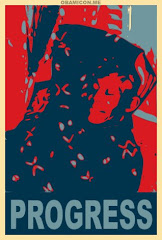
When I travel I like to see which, if any, of the issues that are resonating in the region are also sending vibrations elsewhere. My week in Boston was coming to a close, and my elder daughter and I were on the last day of our quality time together, before she headed back to Virginia and her mother. We decided to go to see the Shepard Fairey retrospective at the ICA (see details). That he had created the now iconic poster of Barack Obama was enough to be excited about. That it was the day of the Major League Baseball All Stars Game, with the POTUS due to make the first pitch was also momentous. So, I'm not sure how we were derailed and ended up instead making a tour of Massachusetts State House, on Beacon Hill and then walking the city in the area around Boston Common. I guess that some civic genes were pulling us that way.

The State House tour itself was interesting enough, given by a young intern on holiday from college. Massachusetts had many key roles in the creation of The Union and its history is so rich that a visit focusing on that is warranted. I was also intrigued to be in a state capital whose governor was a black man, and also a close associate of the POTUS, Deval Patrick.

But on to resonance. As I walked through some corridors looking for my offices, I heard the voice of a man clearly making a set of remarks to reporters, and of all things on health reform (see NY Times report). I listened for a few moments and took a few pictures. As the press report notes, "The new state budget in Massachusetts eliminates health care coverage for some 30,000 legal immigrants to help close a growing deficit, reversing progress toward universal coverage just as the US Congress looks to the state as a model for overhauling the nation’s health care system." The critics' main plaint is that the cut, which would save an estimated US$130 million, unfairly targets taxpaying residents.

The Governor now has a fight on. He has proposed restoring US$70 million to the program, which would partly restore the immigrants’ coverage. But legislative leaders wont have it, arguing that vital programs for other groups would have to be cut as a result. The cut, which would affect only non-disabled adults from 18 to 65 years old, would take effect in August unless the legislature approves Mr. Patrick’s proposal. Ding-dong. Round one.

I thought back to the claims circulating in Barbados about the pressures being imposed on critical services by illegal immigrants. Still waiting to hear some figures, but in the Caribbean "soon come" means something. But, I smiled to myself thinking of the ballooning budget deficit the government there has and that it cannot save money by eliminating coverage for illegal immigrants--they are not covered. Would they think of eliminating it for legal immigrants, though?

The policy now in play in Mass. is the kind of thing that makes legal immigrants say "Hey! That's not fair."

I head back to Bimshire today. I wonder if the vibes from up here will find there way down there.

Saturday, June 20, 2009

Tipping Points

I tend toward a view that, if and when people tell others they barely know about their problems, then the matter is really one that is deep in their core. I'm comfortable believing that when it comes to business activities.

I was at an establishment in midweek, waiting for a group of legal migrants to arrive at the airport from New York. I had been in a series of long and sometimes frustrating exchanges about Barbados' recently announced change to its amnesty regulations for undocumented migrants from other Caricom countries. I was glad to free my head from some of the silly diatribe and try to sift out some of the essential points that were being made.

The manager came along and complained to me and another guy I knew that people were using his establishment as a parking lot. To sour matters, they did not patronize the establishment and buy any goods. "Why not charge a flat fee for parking?" I suggested. He said that he could not do that because the official car park rate was the same. "Well, in that case, those who do not want to pay wont park, so you still win. Those who want to park for a long time could now do so more cheaply, so you win again," I added. He said he did not have the personnel to do that. In all, he resented the intrusion but felt helpless, and taking action like clamping or chaining the vehicles seemed to him like more work than it was worth. I suggested that he give it a try, and see what the reactions were, and I'd check again when I have to deliver my passengers back to the airport on Monday.

I then asked him a question: "When are you due to open each day?" He told me the time and noted my surprised reaction: "I know that we don't open then, because I call in and no one answers," he added. "If it rains, some don't show. If they have a bruised toe, some don't come. If they had a few too many drinks the night before, some don't come." I then asked why he tolerated that from his staff. Why did he not replace them. He then told me that he had plans to do that, but the government was blocking the plans, fearing adverse reactions during the current economic downturn.

There is often an uncomfortable stand-off between private or public entities, unions, employees, and government when it comes to actions that threaten jobs. In the end, if the private sector employer cannot bear the brunt of inefficient or less productive workers, he/she will usually up stakes and close, and then the job losses are there anyway. In the public sector, there may be a stronger push to hive off the entity and let it sink or swim in the private sector, so long as it's not longer a burden on the public purse.

This led me back to some of the discussion on illegal immigrants. It's well known that one of the driving forces is an inability to get certain types of workers from the pool of available nationals. The ethical thing to do would be to go through whatever processes are there to get work permits, etc. and engage legally non-nationals. But, ethics be blowed. People short-circuit the system, often with a complicit blind eye from officials, and bring in people to work whom they know do not have the right to do so. The migrant worker who offers to work without the right documentation, is of course prepared to have lower wages and worse terms and conditions of service than nationals because these are better than would be available in the country from which he/she came. I know that my frustrated entrepreneur would love to be able to take on a willing non-national and have his establishment open on time and the worker come in, no ifs, ands, or buts.

My thoughts also drifted off to the debate going on about productivity (though it's not always couched in those terms). We know that some public sector agencies are in a mess. There is the matter of the Barbados Water Authority (BWA), a corporation that seems unable to deliver water where it should, and is incapable of dealing with wastage of water where it occurs: I have been driving past a leaking pipe for two years, and I heard reports this week of repeated calls to deal with leaking water pipes and stagnating pools that have gone uncorrected for months. It also has a serious arrears problem (the latest reports indicate B$26 million/10,000 accounts in arrears, and 60% of this is owed by residential customers, see Advocate, June 20, 2009, part of the rationale given by delinquent customers is that BWA is slower to disconnect for non-payment and no rewards for early/prompt payment). It is about to be granted an increase in rates, but I have yet to hear of a comprehensive plan to deal with its ills. We read that the Government of Barbados is currently in negotiations with the Inter-American Development Bank and the Caribbean Development Bank regarding a package of measures to reorganise and modernise the BWA (see Advocate, June 20, 2009, front page). I personally cannot see the justification for a rate increase ahead of the reorganization and ahead of any move to bring those arrears down substantially: it sounds like pouring money down the drain.

The private sector has its culprits too, and we've seen, heard and suffered from the poor service doled out by a range of establishments that are supposed to make their livelihood from offering good service. While there may be no conspiracy, there may be an unholy alliance of the sort outlined by the manager of the impromptu parking lot. One of those, of which I have complained in the past, told me recently that they are making efforts to deal with poor customer service as reflected by public and less-visible complaints. That's a step in the right direction in one case, but will it work and will it spread? In the meantime, some prominent commentators continue to give air to their grievances (see "The Lowdown" in The Nation, June 19, 2009)

It's interesting to speculate whether the coming together of discussion on these and other issues of national importance suggest that we may be moving to some kind of tipping point, where lots of things change. How much discontent with the status quo does it take for people to say "enough already"?

Friday, June 05, 2009

You Don't Say

My blogging friend, Ingrid, who is also my friend in a wider sense, has liberated herself from her bind known as writer's block and, so she writes, can once again marry fingers to keyboard happily in rhythmic fashion and craft words and ideas that please her and, I hope, others. But, I too have been suffering in a similar way. My mind has wrestled with a lot, but getting that fight up from the mat of my mind into an arena more visible has been nigh impossible for a few weeks now. You cannot take pills for this. True, I was very excited about my first born finishing university and graduating this past week, and I have played over in my mind a lot of life issue: a child of a divorced couple should always be watch for vulnerability, and the matters that tip the balance need to be noticed carefully. Poor girl, though, with her great degree, now has to try to swim in the economic swamp of a world recession. She wont be alone if she decides that dog walking is the career for the next year: true, no real academic qualifications are needed, but a lot of care and compassion is, and they are worth developing.

Part of my blockage has been built on not knowing whether to caw about some deep issues or leave them for others to mow through. Part has been due to a sort of bleary eyed amazement at the drivel that people do dole out in the form of ideas and opinions. I know that I am not alone in that view and was heartened to hear one of the moderators lay into a few callers for just that sort of thing.

But let's take a look at the drivel factory. I listen to a particular radio call-in program more than I really want to so that I can help the producer by making pithy comments that usually have a beginning, middle, and end. I decided some time ago, that while I can spout out views about almost anything, I would try to build a reputation of having some sense and worthy views on financial topics. I can stand on a soap box to rattle on about other things. But, as I have listened over the past few weeks, I have noticed that few of the commentators seem to have any sense that they can limit themselves. In addition, few can string together some sentences that have any coherence. Few can sense that they are contradicting themselves, as the arguments develop. Few even listen to the moderator asking them to slow down as they press on to make points that make no breeze of sense. I wonder if part of this is because they are trying to listen to themselves on the radio and get confused by what they say and what they hear themselves saying. Few have any facts to support what they say, as they flip subjects when a question is posed. Most use anecdotes as if they are hard evidence but do not see that talking about "Miss Parris" and her sweet breads is not enough to make conclusion about the wider world. Clearly, some love their own voices so much that the more they hear it the more excited they become. Bunch of charlatans or just like most people? Admittedly, people can talk about things that move their emotions and with the Budget and a new government policy on the matter of immigration from other Caricom countries, there has been no loss of topics on which to vent. I have decided to stand aside from that waft of hot air, and tried to think about what I would say if I were to say anything.

I've written a piece on the Budget and now I look to see if what I thought is turning out to be close to what is happening. The one area on which my beady eyes are focusing is that thorny bush of public sector activity. I have not hidden my view that part of the Barbados economic success story is built on some myths, and one of them is about labour productivity. Part of this myth is unraveling, in the form of statements about what the civil service is not doing: the reports of the Auditor General paint a picture of lack of accountability and departments having very little to show for the money that is spent, either in terms of a mission accomplished; some ministerial statements point to the difficulty of getting a day's work for a day's pay out of some public servants. For example, how can the Immigration Department not know basic information on immigrants when every person has to complete an entry form and when the government is shaping new policy on immigration? Some would call this pure slackness. I will watch the wind swirl around this area and see if the dust makes anyone blink.

The deep issues include the matter of what to do about foreigners in your midst. I wont deal with that so much now, but have that gnawing feeling that comes from living most of my life as a foreigner in the midst. But, it's interesting that as economic conditions worsen so does talk of needing to weed out foreigners increase, and one does not need to listen to white skinhead racists in Europe talk about "wogs" and yell "send them back home" to anyone they see who has a dark face. Here in Barbados, we can see that black views on black people can be as villainous as the oft-detested white views on black people. Yet, this is an island whose economy has been built on presenting a welcome mat to foreigners. Now it is struggling with those who come here because economic conditions offer better options than in their homelands, and want to work, or buy land, or own companies, or marry locals, and more.

Now, we know that in the minds of many not all foreigners are the same. When people here think of foreigners they don't like they tend to be those who are 'in competition' for jobs and houses and social services, and that means those coming from other poorer Caricom countries; it could even be made more specific by pointing at Guyanese, Vincentians, Antiguans, Lucians, Jamaicans and some more, including any Chinese or Nigerians who happen to be contracted to work here. It does not really spread to Canadians or Brits or Americans or Mexicans--they tend to be in a world that seems a bit more luxurious and from which many locals are excluded (voluntarily or not). But, I'm trying to figure out how people are drawing the lines. It's not a simple matter of black and white. It may be about perceptions of rich and poor. But what I am also seeing is that the loose lips-shoot from the him thinking of the call-ins is also evident in what some prominent people write. I have to think about why a prominent businessman, like Ralph "Bizzy" Williams, would think it's a good idea to limit voting to people born in Barbados as a means of preserving national 'culture' (see letter), and if he realises that this does not limit rights to those who could claim to be 'truly Bajan'. Reflect on Mr. Williams' views expressed in a letter to the press in late May (my highlighting):

As I see it, the biggest danger to Barbados in allowing foreigners into this island to work and possibly settle is the possibility of a foreign culture being able to determine how we are governed.

There has been non-stop debate about the new Barbados immigration policy announced by our Government in the press and on the call-in programmes, but I have not heard anyone articulate this possibility.

Barbados has traditionally been governed by the BLP or the DLP. The support for these two parties is pretty even and in most cases, seats in an election are won or lost by a small percentage of votes cast. If therefore we allow in and grant residency to foreigners whose culture is unlike our own, we could easily end up with a small percentage of our population that embraces a culture unlike ours determining the outcome of our national elections.

This to my mind is an extremely dangerous possibility because knowing this, our political parties would tend to be very accommodating to the interests of these new residents at the expense of the interests of the wider Barbadian-born population.

The solution to this potential problem is simple. We should only allow people who were born in Barbados to vote in our elections. This would ensure that the shift to the control of the island by a foreign culture would be much slower and everyone who is allowed to vote would at least have grown up in Barbados and had the opportunity to embrace our culture.

I hope this suggestion will be implemented and that its implementation will put to rest the fears of born and bred Bajans who are concerned over losing our homeland to foreigners.


I wonder on whom his eyes are really set. Does he mean the snow bird crowd that has descended from England or Canada, and flaunt such 'foreign culture' as enjoying the Holders season or ice hockey or cheering for Man U? Does he have in mind those who have come from the land of wood and water, who like such 'forrin culcha' as eating patties and drinking a cold Red Stripe? Does he mean those coming from a south American neighbouring country, who love such 'foreign culture' as cook-up rice and say "Jawgetung"? Does he mean those coming from a neighbouring oil baron state who are 'buying up di ilan', party all the time and want such 'foreign culture' as Calypso and steel pan and doubles and roti? So, let's take the votes away from the foreign born people. But let's think about what is happening to so-called local culture if you say to foreigner come and invest in the country; come and spend your vacations here and spend and behave as you would in your home country; sell goods into the country; provide foreign services to the country; come and regularly put on shows on the island, etc. Is local culture somehow safe because these people do not vote. Give me a break!

Those Bajans born here but now residing in England or Canada or the US would be eligible to vote, even if they have lived abroad for decades. The children of legal Caricom non-nationals immigrants born in Barbados would be able to vote. The US Attorney General, Eric Holder, was born in Barbados, so would be eligible, but the present Prime Minister of Barbados, David Thompson, who was born in England, would not. Go figure.

So, I have removed some of the cobwebs from my fingers and the much of the dust that was gathering on the keyboard has been swept away.

Tuesday, May 19, 2009

What A Difference A Year Makes

Barbados got the second Budget from PM Thompson in his guise as Finance Minister yesterday. When he made his first presentation, in July last year, I was close to my radio trying to hear what directions he would try to set, after his party had regained power after 14 years out of office. I was intrigued at how he was going to lay the groundwork to help Barbados weather the advancing storm of a world recession. In his judgement, tax increases were an important part of the necessary measures (see previous post). One of the other messages that was clear to me was a less favourable attitude to foreign property investors, one that has been repeated several times.

This year, I was also close to my radio and watching the performance on TV. I also had the tough challenge of being part of a radio panel later in the evening to discuss first impressions of the Budget. That was no easy task. I found myself alongside the current and previous Ministers of State in the Ministry of Finance, Senator Darcy Boyce and Clyde Mascoll (who is now working as an economist), the president of the Barbados Economics Society, Anthony Johnson, and a well-know accountant, Douglas Skeete. So many economists in one place? Must lead to lots of opinions. So it was, but it was great fun, and we got pizza. I wont pretend that we arrived at any consensus, even on the food. We spent a lot of time talking about the outlook for government debt, which to me is something that should get people's attention.

No one doubts that a politician taking over power during the past two years has had anything other than an economic baptism of fire. But politics is a funny game. I remember when I first got here most of the criticism I heard from Mr. Thompson, when in opposition, was that the economic ills, especially rising prices, could be put at the door of the government of Mr. Owen Arthur. Now that the hat has a new wearer he is quick to point out he was having to deal with 'circumstances not of our making', and much blame is laid on the world recession. I don't have a problem with that observation, but I wonder what changed in the shifting of positions.

The government is in a tough situation. Revenue is less than desired. Spending is higher than desired. Foreign exchange is flowing less than desired, especially because foreign tourists and investors are also facing a tough time. Prices are not falling as desired. Financial institutions are causing clients concerns.

Without going too much into the details of the budget, there is a darkening outlook for Barbados in that it is being increasing perceived as highly indebted, as the pincers of revenue shortfall and expenditure that is not falling fast mean that it has to borrow more. The fact that the so-called debt-to-GDP ratio seems headed to 100 percent is a red flag, and the government's strategy does not see it coming down to around 70 percent until 2018 (a decade away) should give pause for thought. The Budget had a long story of how the credit rating agencies and international financing institutions are laying their beady eyes on this. Barbados should rightly be getting hot under the collar.

Much of the success in economic policy is about confidence and credibility. Barbados needs foreigners' money and it comes in three main forms--from tourists, from those setting up and operating international businesses here, and from investors in real estate on the island. My own view is that the government did not see that nothing should be done to jeopardise any of those pillars especially in the current fragile economic conditions. People are fickle when it comes to putting their money to work abroad. Tough economic conditions in the UK, Canada and the US will crimp tourists arrivals and spending. Plans by the world's economic 'big boys' to rein in what they call 'tax havens' have had Barbados and other countries with relatively low taxes scrambling to paint themselves as less harmful. But, I think the ball was missed in making foreign property investors less welcome, and I fear that once they turn their backs it will be hard to get them to change their minds.

The latest budget did much to allay fears of new tax increases, but at the same time put together measures that were geared to shore up jobs. People's fears of having less in their pockets and maybe feeling less secure at work may well be eased. Those selling motor cars will feel easier with the increasing of the rebate on new vehicles. Many will welcome lower VAT on building materials and the housing measures. Many, however, will wonder how large will be the promised increases in water rates, from July.

There are many dark clouds that need to be cleared. Many people have serious concerns and seek clarity about the real situation with CL Financial and the life insurance company, CLICO. It still is not there. Searching for a private sector solution has many merits but the path to that is leaving many scratching their heads. The creation of an oversight committee which will temporarily be responsible for approving expenditure and decision relating to the financial subsidiaries of CLICO holdings may raise concerns rather than diminish them. Since the problems of CL Financial broke earlier this year, PM Thompson has been trying to pour cold water on concerns about the health of CLICO Barbados. This latest move suggests that more cold water is being dispensed.

Part of the fall out of financial sector supervisory lapses may be addressed with the creation of a Financial Services Commission to oversee all non-bank financial institutions, from the first quarter of 2010. But let's not run with this before we see it walk.

I don't get a sense that the approach to renewal of the Queen Elizabeth Hospital is really the best one.

On of the major challenges is for the government to make all feel that the problem is a national one, not one that is about partisan positions. Mr. Thompson has come up with the "Team Barbados" concept as a rallying call, but I do not feel that it does not do enough to really draw people into a national effort.

Whether the "Barbados experience", which will try to sell all that the country "has to offer in terms of our environment, our friendly people, our international business services, our high quality of life, our cultural services, our tourism experience, our educational standards, our infrastructure, our history, our reputation and our good name" will be more than a marketing slogan, we will have see.

The economic road ahead is not easy but it is also not impossible to pass without falling on sharp rocks. Let's see if people feel ready to help each other walk the road or if they will be readier to push each other over to avoid being the ones to fall.

Saturday, April 25, 2009

Yes We Can! Oh No We Can't.

When I think of disabilities, I have a very wide definition in my head. However, I imagine that other people think mostly of those who are unable to walk (at all or well); the blind and partially sighted; the deaf or hard of hearing; those who have mental problems (from the thoroughly insane to those who have acute mental difficulties, such as the autistic, that make it hard for them to cope with the rest of society); and those who have speech impediments (who cannot talk or talk with problems such as a stammer); and so on. Some of us will also think of persons such as those who suffer from dyslexia. I am not trying to be exhaustive, as I understand the list could be very long if one regards a disability as a condition or function judged to be significantly impaired relative to the usual standard of an individual or group. So, if you are far away from the norm you qualify. It's ironic that President Obama has popularised the phrase "Yes, we can!". In many respects, he is one who could be said to suffer from a disability, being a left-handed person in a world of right-handed people. He struggled to find people to teach him how to write because he was one of the rare group: physically able, but backward when compared to others. "Yes, he could, but with difficulties." I remember the first time I saw a right-handed friend trying to use a standard potato peeler--impossible; now, he could buy a left handed peeler.

Those who fall into such categories have a hard time fitting in. Or, maybe it is better to say that those who do not fall into such categories have a hard time accommodating those whom we see as disabled (or less able, or 'challenged' in some way, if one seeks some sort of politically correct adjective).

If you walk around and just try to figure out how people who are not normal, or standard, can cope, it is not hard to wonder how they can get through a day. Go to store or almost any building here in Barbados. Does it have a ramp for those who cannot step up? Is there any sign in Braille or with an audio function for those who cannot see? Imagine a blind person trying to use an ATM machine. Once you can see the slot for your card you can figure out how it should be inserted. Once inside the booth are the keys fitted with Braille? If you want to make a deposit how do you do that if you cannot see or read the instructions that come on the screen? And so on. I was crossing the road to school last week and after pressing the button at the traffic light to allow me to cross, I realised that unlike in many countries there was no sound to tell me that it was time to cross. I started off carefully as I saw three lanes of traffic stop but noticed a fourth lane with a car hurtling on. I waited in the middle as the driver sped through the red light. Oh, I was so glad that I was not blind and somehow just stepped on the crossing regardless of danger.

Some would say that the world as designed by normal people cannot cope with everyone who is not standard issue. True enough. Most people don't care until they start to have problems themselves when trying to do something simple.

As I try to teach my daughter to read and write, I'm glad as she starts to cope with recognizing letters and form and say them in a way that is familiar. As she starts to recognize words on signs, I can breathe an inner sigh of relief that I will not have to deal with a child who may need to learn differently. I had that sigh pushed back down my throat as I spoke yesterday to a friend whose granddaughter has now been diagnosed as dyslexic. Now, that child's inability with reading while coping well with arithmetic has some basis. The child was not being difficult or lazy, as she could often be labelled. She could not understand. But, what to do next? Special school? Special teacher? Deal with it at home?

In Washington DC, every road intersection has a slope so that anyone who is in a wheel chair can cross easily. In Germany, every road crossing at a traffic light has a sound signal. Is it only richer countries that will spend to cater in this way?

Once your good faculties start to falter you start to understand what some have had to deal with for a very long time.